Submarine Collision off Murmansk:
A Look from Afar
by Eugene Miasnikov
(as submitted for publication) This paper was published in DACS
Breakthroughs magazine (Defense and Arms Control Studies Program at
M.I.T., Winter 92/93, v. 2, # 2, pp 19-24) and reprinted in The Submarine
Review (April, 1993, pp. 6-14). The paper analyses the plausible reasons,
which lead to a Russian (of "Sierra" class) and a U.S. ("Baton
Rouge") submarines collision incident in February, 1992. The author
comes to the conclusion, that most likely, the reason was very short
detection range of submarines, because of that both submarines operated
covertly and did not use other means of detection except passive acoustics.
There are no reliable means available to submarines that would allow them to
operate both covertly and safely in such a complex environment as shallow
waters. The collision illustrates that covert operations of foreign submarines
close to Russian naval bases can create dangerous situations that may result
in undesirable outcomes. |
On February 11, 1992, two Russian and American submarines collided in or
near Russian territorial waters off the port of Murmansk. While such submarine
collisions have occurred before, the most recent collision seems to have
generated more response in the press than previous ones. Differing and
contradictory press accounts of the collision, published in both the US and
Russia, raise two questions: What was the US submarine doing so close to the
Murmansk naval facilities? And how could such a collision have occurred?
These two seemingly simple questions, however, raise a third question that
points to issues of prime importance for security planning in both Russia and
the US: Does this collision tell us anything important about the capabilities
of US submarines to conduct antisubmarine operations against the newest
generation Russian submarines? If so, could this incident indicate that current
and future generations of Russian ballistic missile submarines could be held at
risk by US Navy undersea forces? In this paper, we examine these questions
using both Russian and American sources, and a technical review of the
capabilities and limitations of submarine sensors in shallow coastal waters.
In particular, our analysis indicates that in the shallow northern seas,
even under the best environmental conditions, the technical capabilities of
modern covertly operating submarines do not allow the detection of other modern
covert submarines at distances of more than a couple of hundred meters.
The USS Baton Rouge, a Los Angeles class nuclear attack
submarine1
and the Russian Sierra class submarine collided at 20:16 Moscow time, at 69o38.7'
North and 33o46.9' East, roughly 4.7 miles from the line connecting
Tsypnavolok Cape and Kildin Island (see map below).2 The US Navy
stated that the collision occurred more than 12 miles from the shore, at a
location in international waters. However, Russia uses a different set of rules
for defining the boundary between territorial and international waters,3 and the
Russian rules put the collision site inside their territorial waters.

The dispute over exactly what areas
of coastal ocean can be considered international waters is important since
international coastal waters can be used for a wide range of activities and
many questions of rights and "rules of the road" are effected by
whether or not naval operations occur within territorial or international
waters. In the particular case of Murmansk there are obvious additional
concerns about the security and operation of Russian warships near their home
port. The Murmansk area contains the largest base of the Northern Fleet.
According to US officials, the
collision occurred when the Sierra was surfacing beneath the Baton Rouge, which
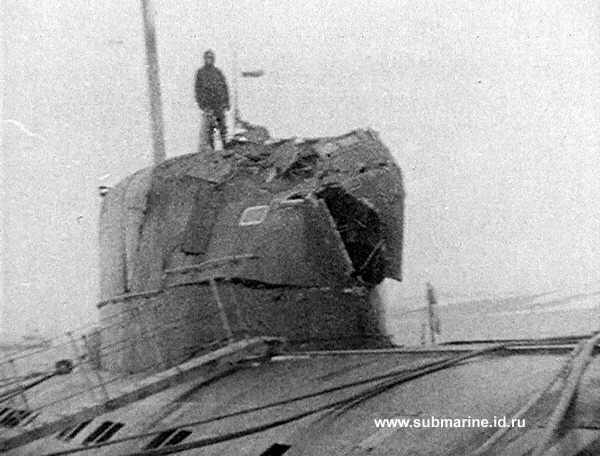
was at a periscope depth of 22 yards.4 US
reconnaissance photos of the Sierra reportedly showed a large dent in the front
section of her sail structure and indicate that the Russian submarine's sail
may have hit the underneath aft section of the Baton Rouge.5 According
to Soviet reports,6 the Sierra
incurred slight damage to her sail, where substantial bits of the U.S.
submarine's skin - ceramics, plastics, and other components - were found.
Reportedly, after the Baton Rouge had returned to her base in Norfolk two weeks
later, divers conducting an underwater inspection found scrapes, dents and two
minor cuts to her port ballast (one of two on the submarine).7
Fortunately, the accident did not cause any injuries or deaths.
The U.S. Navy has not released an explanation of why the
Baton Rouge was operating so close to the Russian coast. However, sources
within the Pentagon have reportedly said that the Baton Rouge was on an
intelligence gathering mission at the time of the collision.8 This
explanation has also been brought up and discussed in other press accounts of
the collision as well.
There are several kinds of
intelligence missions that could, at least in principle, have brought the Los
Angeles class submarine so close to the Russian coast. One type of mission is
simply aimed at gaining experience operating in shallow waters as close as
possible to the Russian coast. Although one press account stated that
"there is little if any tactical reason these days for American submarines
to operate so close to Russian shores,"9 the US Navy
may not yet have reached the same conclusion.10 The
gathering of intelligence with submarines may also be able to provide
information on aspects of Russian Naval operations that could be useful in
helping to predict the actions and movements of the Northern fleet.11 According
to knowledgeable sources in the Russian Navy: "Intelligence gathering is a
routine activity of American subs near our coast. Typically, there are one to
two American or British submarines operating close to the Soviet coast off
Murmansk, 1-3 off the Kamchatka peninsula and 1 off the coast of Vladivostok.
During naval exercises this number can increase by a factor of two."12
Gathering intelligence either
inside or just outside Soviet territorial waters has been a long-term program
of the American Navy, and has been given names such as Holystone, Pinnacle,
Bollard and Barnacle.13 These
activities apparently included close-up photography of the undersides of Soviet
ships and submarines; plugging into Soviet underwater communication cables to
intercept high-level military and other communications considered too important
to be sent by radio or other less secure means; observation of Soviet SLBM
tests including monitoring of the various computer checks and other signals
that preceded test launchings; and the recording of "voice
autographs" -- the noises made by operating Soviet submarines. One
possibility, consistent with reports that her mission was intelligence
gathering, is that the Baton Rouge was on the mission to install (or recover)
intelligence gathering devices from the seabed near the shore.
Press speculation that the
"American submarine, which...was sitting at 'periscope depth', may have
been using secret interception equipment to monitor communications at nearby
military bases"14 is
implausible for two reasons: First, continuous radio interception of military
communications can be accomplished without the use of a submarine.
Communications intercepts can be accomplished with surface ships operating from
international waters, and intermittent interceptions can be accomplished with
satellites orbiting in space. Second, a submarine periscope or antenna sticking
out of the water can be observed by a variety of relatively long-range sensor
systems - in particular by modern radars.15 As a
result, unless there is a compelling reason to argue otherwise, it is unlikely
that a submarine commander would be willing to keep a periscope mast deployed
for a substantial period of time in such close proximity to a potential enemy's
surveillance systems and forces.
According to one Soviet press report,16 the collision
was the result of a cat-and-mouse game between the US and Russian submarines.
This possibility deserves detailed study, since it could indicate that the US
might still retain substantial capabilities to trail Russian ballistic missile
submarines.17
Since the Baton Rouge was operating
covertly close to major Russian Naval facilities, it is highly unlikely that
she would have used her active sonar during normal operations. Such a practice
could greatly increase the likelihood that her presence would be detected. It
is also unlikely that she would have been using her long towed array. The
length of such an array with towing cable is more than 1 km, many times the
water depth at the place of collision.18 In
addition, it is difficult to control an array's orientation in the water
without severely constraining the motion of a submarine. Such constraints are
highly undesirable when operating in close proximity to potentially hostile
forces. Thus, even though using her towed array would substantially improve her
detection capabilities, it is unlikely that the Baton Rouge would have this
type of sensor system deployed in shallow waters. Hence, she was almost
certainly using only her fixed passive sonar systems while she was operating in
the shallow waters off Murmansk. This conclusion allows us to estimate her
detection and counterdetection capabilities against the Sierra submarine she
was allegedly tracking.
There are three reasons why the
submarine passive acoustic detection ranges would have been short in the place
of collision.19
First, in shallow waters, the ambient noise levels from wind-generated breaking
waves are typically 10-100 times higher than those in deep water. This noise
generates background signals that can mask the presence of a signal from even a
nearby submarine.20 Second,
in shallow water, the acoustic signals from a target submarine will arrive at
the acoustic detectors of a hunting submarine from many different directions
and at many different times. This is because sound waves generated by a
submarine will be reflected from the constantly shifting ocean surface and from
numerous locations on the ocean bottom many times before they arrive at the
face of an acoustic detector. Since the signals from a target and from breaking
waves both unpredictably come from many directions, there is no way to enhance
the signal from a target submarine relative to that from interfering wind-noise
by increasing the number of receivers and the size of array.21 Third,
there are no sound focussing effects in shallow waters, as there are in deep
water, that can make it easier to detect the submarine against the background
of ocean noise. Such deep water effects can strongly focus the sound from a
localized sound source like a submarine at well defined distant ranges in the
ocean. At the same time these effects only weakly focus the diffusely generated
sounds from wind-generated noise.22
Quantitative analysis shows that
the shallow water detection range of the fixed sonar of the Baton Rouge against
a quiet23
Sierra class submarine would only be a couple hundred meters - even if the
acoustic conditions for detection were nearly ideal and the submarine was
oriented so that its sensors could achieve maximum sensitivity. Near ideal
acoustic conditions could occur only in extremely calm seas. For environmental
conditions that are much more typical of the waters off Murmansk, like those
associated with a 10 knot surface wind,24 noise
levels would be high enough to result in the same short detection range of even
if the Baton Rouge were using a long towed array. Making matters worse, it is
likely that the Sierra may have encountered the American submarine from behind.
In this circumstance, the Baton Rouge would have had no ability to detect the
approaching Sierra, as the fixed sonar on the submarine cannot detect the
signals within a cone 60 degrees to the rear of the submarine.
Even if some unexpected combination
of events led to the detection of the Sierra, the fixed sonars on the Baton
Rouge could provide very little useful information about the direction and
range of the Sierra. These detection and tracking limitations are a consequence
of the relatively small size of fixed hull arrays and the highly unpredictable and
variable transmission efficiency of underwater sound.
The arguments above do not support
the speculation that Baton Rouge was trailing the Russia submarine. It would
have been very hard for the Baton Rouge to do so in this particular situation.
Clearly, the conditions for the Sierra to detect the Baton
Rouge by passive acoustic means were no better. As we have learned from
informed Russian sources, there are specific safety rules for the safety of
submarine operations in such a complex environment. The area of a submarine
operations is closed to any shipping. The submarine is supposed to
"look" around with using her sonar every hour and every time when her
depth of operation is changed. In order to do this a submarine has to move
along a loop shaped trajectory, because her sonar is deaf in the aft direction.
It is possible also that the
Russian submarines may use their sonars in an active mode as a standard
operational procedure, when they do not need to be covert in their home waters.
The use of an active sonar could allow the Sierra to increase her detection
range to a couple of kilometers and to obtain much more detailed target
location information. It appears, however, that she was not using her active
sonar, since the American submarine would have heard the approach of the Sierra
and determined the bearing of the Russian submarine25 at a
distance of at least several kilometers, which is enough to take care to avoid
a collision. In fact, in this situation, the Baton Rouge would have detected
the Russian submarine long before she was detected by the Sierra.26
It is also interesting to consider
two related questions: What were the potential capabilities of the Russian ASW
forces to detect the Baton Rouge? Would it have been possible to avoid the
accident if the Northern Fleet ASW forces acted properly?
Most likely, the American sub had
to pass a Russian seabed passive (or active) sonar system near the approaches
to the Russian shore. The detection range against a quiet Los Angeles class
submarine of such a passive system might be about 1-5 kilometers in the best
conditions of a calm sea. According to the Russian Chief Navigator Valery
Alexin, several fishery ships were present, the screws of which generated noise
similar to that of the American submarine.27 These
fishery ships might substantially mask the Baton Rouge, although it seems
improbable that such ships were actually present, since the Russian Navy is
typically very cautious about permitting civil ships in the operating areas. Using
a passive seabed system the location of the submarine could be determined more
accurately than by using a towed array, but probably not better than 1 or 2 km.
If stationary active sonar techniques were employed,28 the
detection range would be restricted by surface and bottom reverberations and
might not exceed 5 km.
The Baton Rouge could also have
been tracked either by a ship's active sonar at a range of no more than 1 or 2
km or by sonobuoys which could be deployed by aircraft. The detection range of
active sonoboys most probably was not more than 1 km for this particular case.29 A
possible means of locating a submarine more precisely could be airborne
magnetic anomaly detection (MAD) and lidar sensors.30
As a result, it appears unlikely
that the Russian ASW Forces detected the American submarine before the
collision. As the estimates above indicate, substantial capabilities would be
required to keep even a relatively small area safe from invasions by foreign
submarines. Most probably, on routine duties, less capable forces are deployed,
and this might be the reason why the American submarine was not detected.
In spite of the claims in the news reports, it appears
likely that neither submarine heard the other before the collision and that the
collision was a basically an accident. Playing an extended cat-and-mouse game
would have been impossible there because of very short detection ranges that
would be possible against quiet submarines. Moreover, there are no reliable
means available to submarines that would allow them to operate both covertly
and safely in such a complex environment as the shallow waters of the Barents
sea.
The circumstances of this collision
suggests that, at least in some environmental conditions, if carefully
operated, modern Russian submarines are almost impossible to detect by passive
acoustic methods, even by the highly capable ASW forces of the United States.31 If true,
this has important implications for the options available to Russian policy
makers as they decide how to implement the nuclear reductions called for by the
START agreement as well as possible future deep reductions in strategic nuclear
forces.
The great emphasis that has
recently been placed on assuring the safety and security of the nuclear weapons
of the former Soviet Union stands in sharp contrast to the circumstances of
this incident. The recent collision illustrates that covert operations of
foreign submarines so close to Russian Naval bases can create dangerous
situations that may result in unpredictable outcomes. More than half of the 54
Russian strategic submarines, each with 16-20 nuclear missiles, are still based
near Murmansk. This suggests that any benefits accrued by US attack submarines
operating so close to Russian port facilities may be offset by the risk that a
nuclear weapons related accident might eventually result.
I gratefully thank Prof. Theodore Postol and Dr. George Lewis
at the DACS Program of MIT for very helpful advice and discussions during the
whole time of my work on the subject considered in this article. I would also
like to thank Prof. Ira Dyer at the Ocean Engineering Department of MIT for the
help in estimating of the detection capabilities against submarines by
acoustical means and the high ranking officer in the Russian Navy, former
captain of a nuclear powered submarine, whose name I can not mention, for
valuable comments on tactics of submarine operations. I am also thankful to Dr.
David Wright at Federation of American Scientists, Matthew Partan at the DACS
Program of MIT and Paul Podvig at the Center for Arms Control, Energy
and Environmental Studies in Moscow Institute of Physics and Technology for
their comments and suggestions when this article was under preparation.